By Gracie McKenna
From the outside, the former Hudson River Psychiatric Center looks like a place caught between ruin and redevelopment. The buildings are decaying, the windows are broken, and the old brick and Gothic details still make the campus feel strangely beautiful, even as it is being slowly stripped away. On a recent visit near the site, the most noticeable thing was not active demolition, but the lack of it: empty construction equipment, parked bulldozers and a quietness that made the property feel abandoned twice over.
For Marist students, the site has long carried a kind of unofficial mythology. Sitting just north of campus along Route 9, the former hospital is close enough to be visible and mysterious enough to attract curiosity. Students have described it as a place people sneak into to explore, take photos or smoke weed, even though the property is closed to the public and considered unsafe. That reputation is part of what keeps the hospital alive in local memory: not as a functioning institution, but as a forbidden landmark.
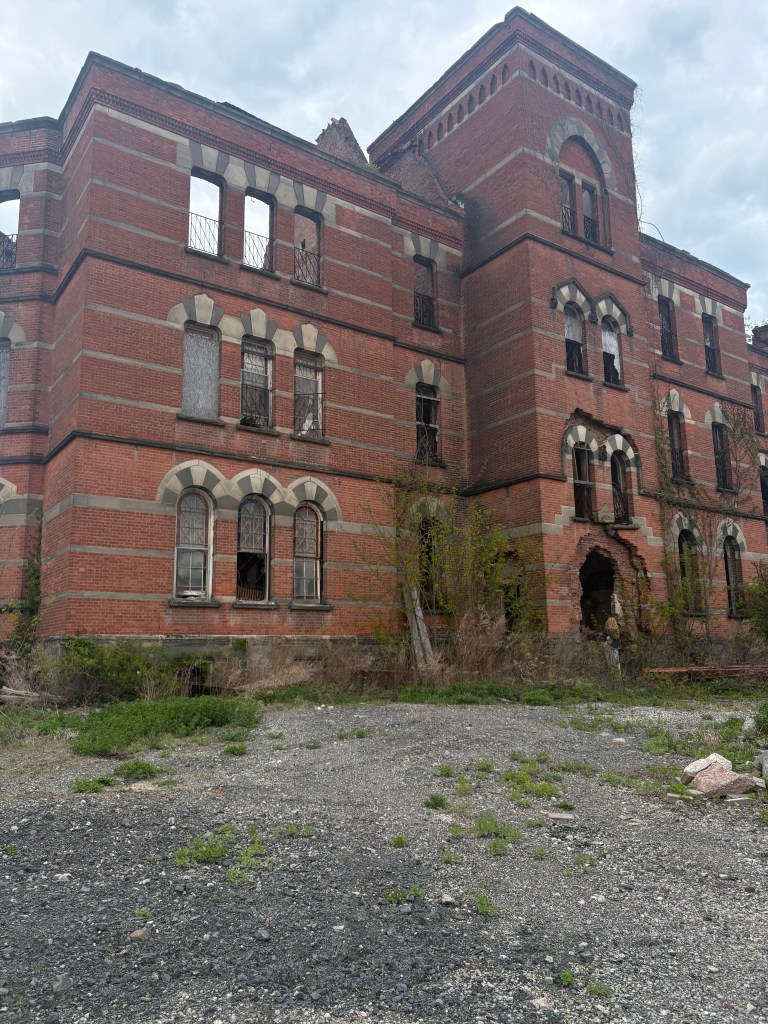
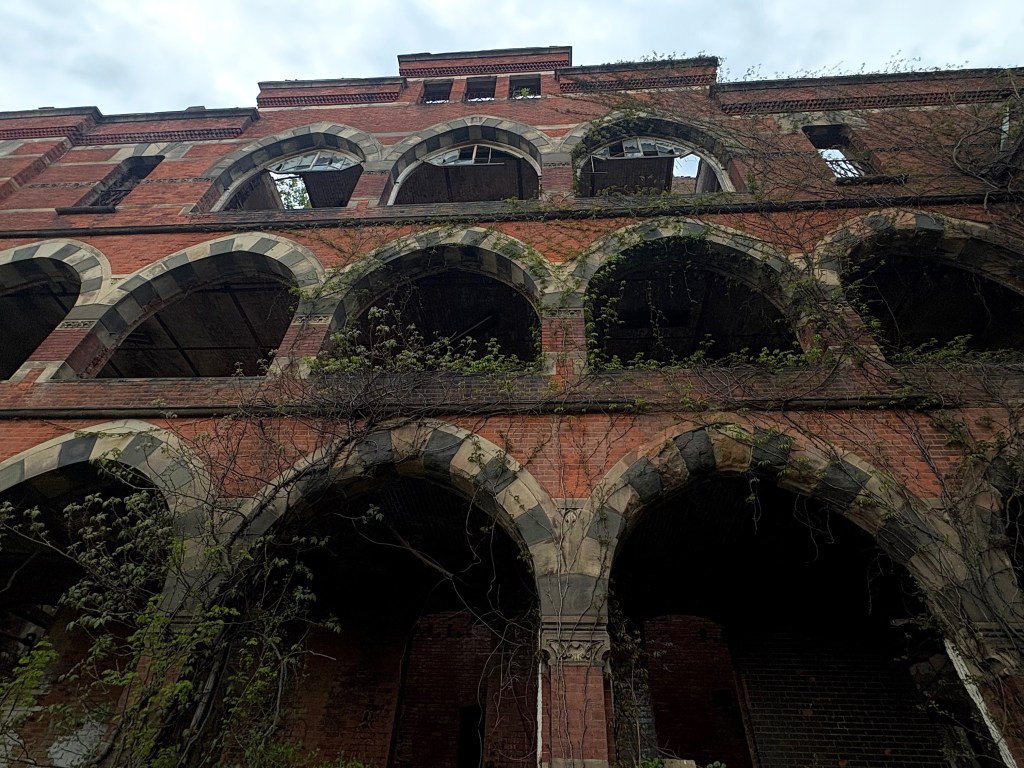
The Hudson River State Hospital, often referred to in connection with the later Hudson River Psychiatric Center, opened in the 1870s as part of a broader 19th-century movement to create large psychiatric institutions outside crowded cities. The main building was designed by Frederick Clarke Withers in the High Victorian Gothic style, while the grounds were influenced by landscape architects Frederick Law Olmsted and Calvert Vaux. The campus later became known for its Kirkbride-style design, a model that connected architecture, landscape and mental health treatment through light, air and open space. The main building was designated a National Historic Landmark in 1989.
For much of its history, the hospital reflected both the optimism and the problems of institutional mental health care. These large psychiatric campuses were built with the idea that environment could help treatment, but over time many became overcrowded, underfunded or outdated. By the late 20th century, mental health care had shifted away from massive inpatient hospitals and toward smaller facilities and outpatient models. The Poughkeepsie campus gradually emptied, with parts of the institution closing through the 1990s and early 2000s. The older campus closed in 2003, while the nearby psychiatric center’s services eventually ended in 2012.
After the closure, the property became one of the Hudson Valley’s most recognizable abandoned sites. Fires, trespassing, vandalism and weather damage accelerated the decline. A 2007 fire badly damaged part of the campus, and another fire in 2018 was reported as intentionally set. Local officials and firefighters have repeatedly raised concerns about security, especially because abandoned hospital buildings are dangerous even when they appear stable from the outside.
The current demolition is tied to Hudson Heritage, a large mixed-use redevelopment project planned for the former hospital property. The project has been described as a roughly $300 million redevelopment that would bring housing, retail, restaurants, office space, medical space, a hotel and other uses to the 156-acre site across from Marist. Earlier plans also called for hundreds of residential units and major commercial space.
That explains why parts of the campus are being demolished: many of the buildings are too damaged, unsafe or impractical to reuse. Developers and planners have framed the project as a way to transform a long-vacant property into something economically useful while preserving selected historic features. LaBella Associates, which worked on the project, describes the plan as one that reuses buildings “where feasible” while respecting environmental limitations on a site with more than 75 buildings and historic landscape features.
Still, the demolition has left some locals uneasy. The old hospital is not just another abandoned building. Its architecture is part of why people are drawn to it in the first place: the towers, brickwork, arched windows and overgrown grounds give the campus a visual identity that newer development cannot easily replace. Preservation groups have emphasized the hospital’s national significance and warned that the site remains at risk because of uncertainty around redevelopment.
At the same time, support for preservation is complicated by the building’s history. Some people see the hospital as a beautiful historic structure that should have been saved more aggressively. Others see it as a symbol of a painful era in psychiatric care and are less sentimental about its demolition. The result is a local debate that is not simply “save it” versus “tear it down,” but a more uncomfortable question: how does a community preserve architecture connected to suffering without romanticizing the institution behind it?
The reason the demolition feels so slow is that the project itself has moved slowly for years. Demolition began in 2016, but the full build-out was expected to take eight to 10 years, meaning the property was never going to be transformed quickly. The site is massive, historically sensitive and environmentally complicated. Some buildings require demolition, others are supposed to be preserved or adapted, and redevelopment also depends on approvals, financing, infrastructure and market conditions.
That drawn-out timeline helps explain the strange scene students and locals still notice: construction machines parked on site, sections cleared away, but no obvious daily rhythm of workers tearing buildings down. From the outside, it can look like nothing is happening. In reality, the property appears to be stuck in the slow middle stage of redevelopment, where demolition, preservation planning and construction do not always happen visibly or consistently.
For Marist students, that emptiness only adds to the fascination. The former hospital feels close enough to campus to be part of student life, but distant enough to feel like a secret. Its reputation as a place to explore or hang out illegally says as much about the site’s limbo as it does about student curiosity. When a historic property sits vacant for years, it becomes vulnerable not only to decay, but to reinvention by the people who sneak through it.
The Hudson River Psychiatric Center is now being taken apart, but not quickly enough to erase it. Its ruins still hover over Route 9 and the Marist area as a reminder of Poughkeepsie’s past, the failures and ambitions of old mental health systems, and the uneasy tradeoff between preservation and redevelopment. For now, the site remains suspended between history and construction: too dangerous to be romanticized, too architecturally striking to be ignored, and too unfinished to feel like its story has ended.
 SayGoodnightGracie.Org
Leave a comment